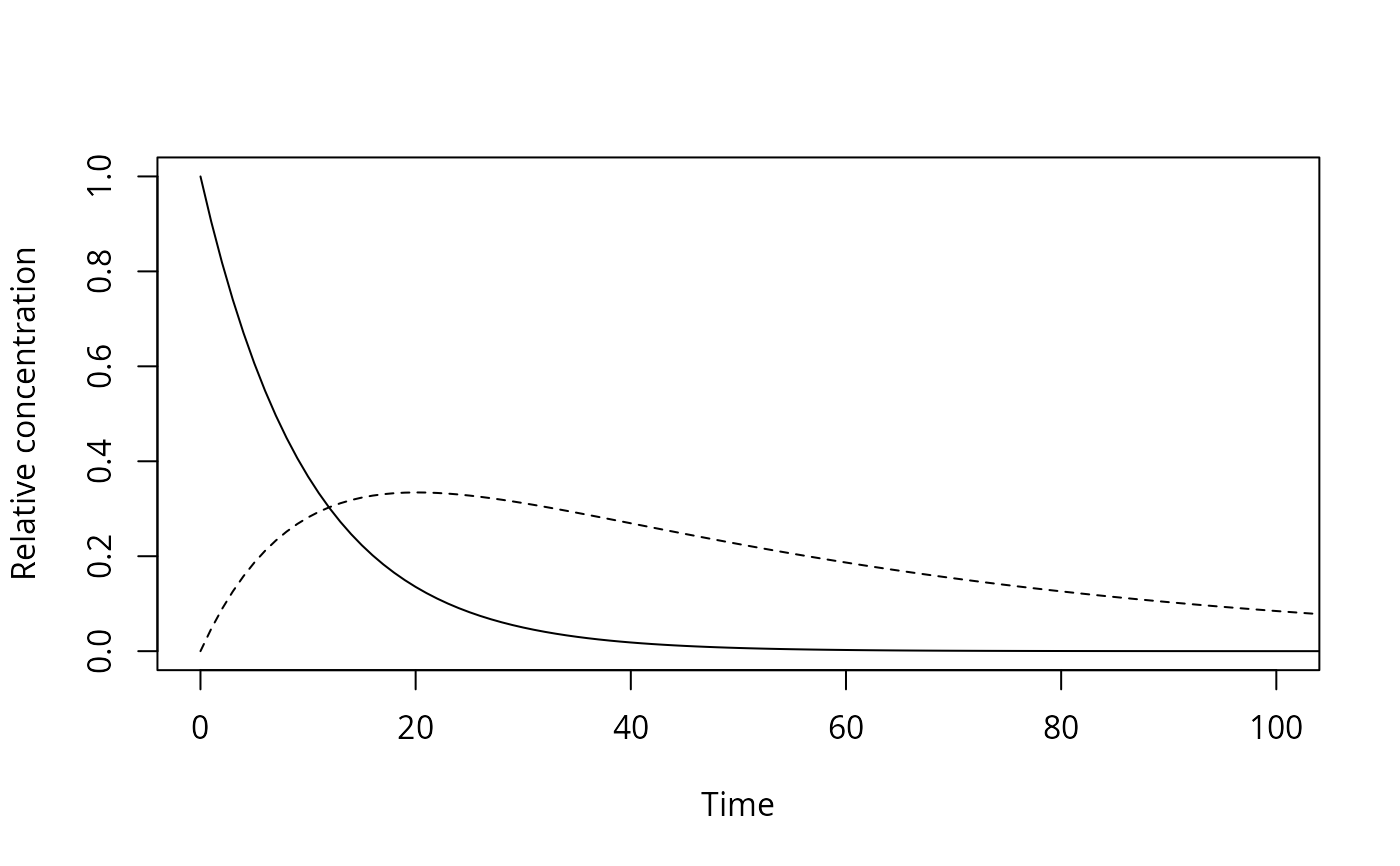
Calculate a time course of relative concentrations based on an mkinmod model
Source:R/pfm_degradation.R
pfm_degradation.RdCalculate a time course of relative concentrations based on an mkinmod model
Arguments
- model
The degradation model to be used. Either a parent only model like 'SFO' or 'FOMC', or an mkinmod object
- DT50
The half-life. This is only used when simple exponential decline is calculated (SFO model).
- parms
The parameters used for the degradation model
- years
For how many years should the degradation be predicted?
- step_days
What step size in days should the output have?
- times
The output times
Value
A data frame containing the output times and the concentrations assuming initial concentrations of 1 for the parent and zero for metabolites, if any.
Examples
# Simple example of an SFO decline curve
sfo_out <- pfm_degradation("SFO", DT50 = 10)
head(sfo_out)
#>   time    parent
#> 0    0 1.0000000
#> 1    1 0.9330330
#> 2    2 0.8705506
#> 3    3 0.8122524
#> 4    4 0.7578583
#> 5    5 0.7071068

# Fictive example with a metabolite where we first generate an SFO-SFO model
sfo_sfo <- mkinmod(
  parent = mkinsub("SFO", to = "metabolite"),
  metabolite = mkinsub("SFO"))
#> Temporary DLL for differentials generated and loaded

sfo_sfo_out <- pfm_degradation(sfo_sfo,
  parms = c(k_parent = 0.1, f_parent_to_metabolite = 0.5, k_metabolite = 0.02))

plot(
  sfo_sfo_out[, "time"],
  sfo_sfo_out[, "parent"], type = "l",
  xlab = "Time", ylab = "Relative concentration",
  xlim = c(0, 100))
lines(
  sfo_sfo_out[, "time"],
  sfo_sfo_out[, "metabolite"], lty = 2)